
The Man Without Qualities (Part 3 and beyond)—Robert Musil
Philosophy as fiction, fiction as philosophy

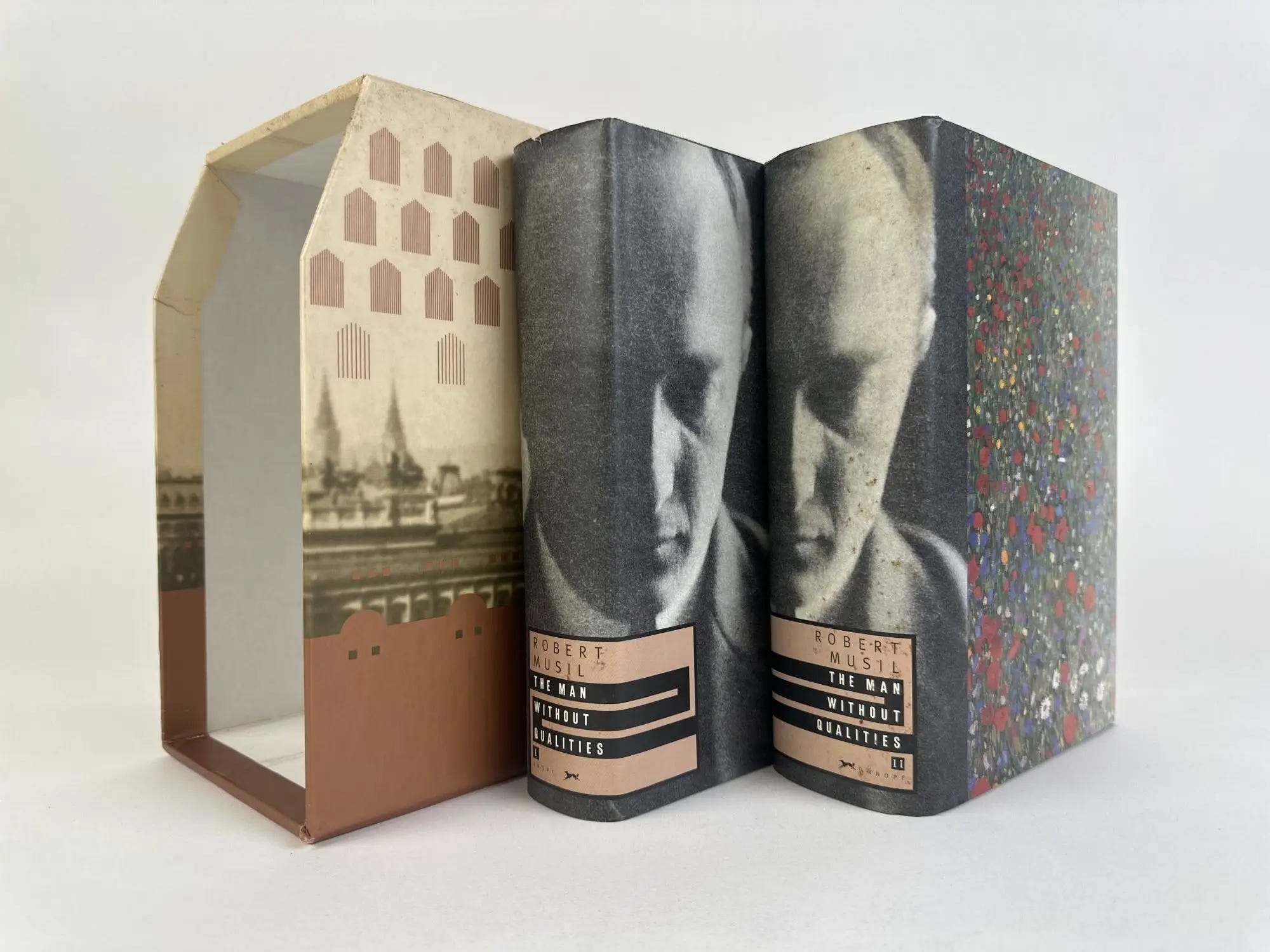
I finished Musil’s masterpiece, The Man Without Qualities, albeit later than planned. You may want to remind yourself of what I said after reading parts one and two here.
At the end of part two, a surprising development occurs: Ulrich receives news that his father has died. That circumstance promises to overturn Ulrich’s lifestyle if the estate turns out to be sizable. As expected, part three begins with Ulrich returning to his childhood home to oversee the funeral arrangements; but the sudden twist that upends everything has nothing to do with the inheritance. Rather, he meets his sister Agathe, a previously unmentioned character, and the rest of part three explores their relationship.
When I reached the end of what Musil had allowed to be published of part three, I planned to stop. That would have been all that was ever published in his lifetime. However, since Musil had written but withdrawn twenty chapters just as the book was going to press, and since those chapters were included in the edition I have, I thought I would just take a little peek at the first of those withdrawn chapters.
It was too good; I had to keep going. At the end of the published chapters, Agathe, in a moment of despair, had met a man who seemed to be a savior, pulling her back from the depths. This new character seemed destined to play an important role, but the book ended too soon. The excised material, however, began with a full description of him. And he turns out to be less caring than he had seemed. In fact, he was downright small-minded for a savior:
[…] he was one of those right-minded people who descend from the unimportant to the trivial without noticing. (p. 1135)
I’m glad I kept going, because this new storyline wasn’t all. Those last twenty chapters contained a key to understanding some of the puzzling features of Musil’s style.
Musil’s writing is unique. When you start reading this book, you need to check your impatience at the door and just submerge yourself into a warm marinade of words. He takes a voluptuous, lethargic approach to each thought, feeling, scene, or character description. The most uneventful scene may take many times longer than I would have thought possible, yet I never feel that he is padding. Every word counts.
I thought a long time about what characterizes his writing style. He uses imaginative, startling analogies with almost every breath. Through these analogies the narrator comes across as someone circumspect and ironically reserved. The characters too have their own vocabulary and a manner of speech perfectly suited to each of them. In long, winding paragraphs, filled with microscopic observations of psychological states and processes, the narrator somehow captures the inchoate quality of each character’s feelings and the wordless states they are in just before they speak, surprising even themselves with what comes out of their mouths. Here’s one example of Ulrich, a mathematician, made comic by being so systematic:
What he felt was: “That’s the way it is now!” And what he thought was: “Whenever I succeed in shedding all my selfish and egocentric feelings toward Agathe, and every single feeling of indifference too, she draws all the qualities out of me the way the Magnetic Mountain draws the nails out of a ship! She leaves me morally dissolved into a primary atomic state, one in which I am neither myself nor her. Could this be bliss?”
But all he said was: “Watching you is so much fun!” (pp. 1019-1020)
Despite the sometimes overwrought prose, the paragraphs have a distinctly lilting quality as one idea progresses into the next. In fact, one of the translators explained that Musil would read his drafts aloud to assess the balance and flow of their sound, making the task of translation doubly hard. I thought the musicality came through very well, by the way.
l wanted to read Musil because Flaubert’s Sentimental Education had supposedly influenced him, and I wanted to see what form that influence had taken. I think the influence lies in the realism with which both authors evoke a scene. Their voices are very different, though. So different that at first I could see little resemblance. Flaubert’s narrator is cold, highly detailed, and non-judgmental while Musil’s is lyrical and ironic. Flaubert’s descriptions seem more about historical accuracy, while Musil’s are about psychological honesty. Here is a typical example of a simple action. Agathe is moving in with Ulrich and unpacking her bags.
[…] Agathe’s suitcases were next, and however few there seemed to be, they were inexhaustibly crammed with exquisitely folded things that spread open as they were lifted out, blossoming in the air just like the hundreds of roses a magician pulls from his hat. (p. 973)
Musil fills 1,300 pages with such perfectly worded, evocative descriptions, making this into an aesthetic experience I wanted to never end. And it never does, come to think of it. Like a soap opera with no season finale, new characters keep appearing and opening up new directions the story could take.
It’s clear that Musil cares more about the foreplay than the climax. He sets up a tension that never resolves, or he hints at an emotional development that doesn’t occur. As a reader, I was in a continual state of expectation, like I was watching a lit fuse burn down and disappear into a firecracker.
As an example of one such technique a man and a woman in the same room together would always produce some sort of sexual energy—unless they are married to each other or breaking up. Even Ulrich and his sister have sparks flashing back and forth between them. In a normal novel, that kind of dynamic would lead to an affair or at least some romantic involvement. In this novel, the characters, not the demands of plot, determine how the story unfolds.
He sometimes would set up ominous conditions that would hang over the characters. For instance, Moosbrugger, the convicted murderer I mentioned in the first post, gets sent to an insane asylum to rot. Clarisse, Ulrich’s somewhat unstable friend, has taken an interest in the Moosbrugger case and made it into something of a cause. That subplot develops to where she gets a guided tour through increasingly menacing wards of the asylum, but the visit gets cut short without her getting to see Moosbrugger, and we never learn of any further developments. Various continuations of that plot do exist in the posthumous papers, but we don’t know which path Musil would have led us down.
One thing that does get fully fleshed out is a philosophical theory of emotion. Ulrich has been writing a series of notes in his diary which Agathe discovers and reads. This theory gets presented only in the twenty excised chapters, and it explains a lot of what had been puzzling me throughout. I had been noticing that Musil seldom describes the inner states of the characters as most authors would in a simple judgment. Musil’s characters tend to drift into an emotion through some sort of indeterminate process.
Here’s a typical example, Ulrich is paying a visit to his cousin, Diotima, while she is sick in bed, surrounded by books. When he makes out some of the titles, he is surprised to see they are about bodily and spiritual hygiene.
“Someday he’s going to hurt me!” she suddenly thought, following his glance and troubled by it, but it did not enter her consciousness in the form of that sentence: she merely felt much too defenseless as she lay there in the light under his gaze and struggled to recover her poise. (p. 888)
Musil’s description of thoughts and emotions is so unusual and so consistent, that it was clear to me he was working from some theory about the phenomenology of emotions. Whatever he was doing, I thought it very convincing, despite its unfamiliarity.
We find out in the final, unpublished chapters, that Ulrich (standing proxy for Musil, I believe) thinks of emotions as a bridge between subjectivity and objectivity—between a person’s inner depth and his or her outer surface. Every emotion presents a physical surface through bodily changes such as a quickened pulse, a sharp intake of breath, altered facial expressions, and so forth. But one’s behavior also provides feedback to oneself and actually shapes an amorphous feeling into a recognizable emotion, say by latching onto a particular object. These inner and outer processes create a feedback loop that pulls the mind along as the emotion crescendos, crests, and fades away. So, a vague unease may coalesce into anger at a spouse. Emotions start off as less of a state than a process that evolves toward a state. So, in the passage quoted above, Diotima’s vague feeling of defenselessness coalesces into a specific fear of Ulrich. Thus an emotion stands in the middle between consciousness and behavior.
This theory of the emotions answers the biggest question I had about Musil’s narration. In scene after scene, the characters surprise themselves by saying or doing things that they had no intention of saying or doing. Musil does not offer this theory as his own. He let’s Ulrich develop it in his diary and in conversation with Agathe. But it takes up several of the twenty excised chapters, and turns the final chapter into a sort of philosophical coda, as Ulrich reflects on how to organize his ideas. The concluding words of the novel are, “And so he wrote down what he had thought.”
The book may have come to a nice philosophical resting place, but it was miles away from resolving all the dangling subplots. Tolstoy ended War And Peace with a treatise on history. Musil closes The Man Without Qualities with a treatise on the emotions. I could see how such disregard for the reader’s expectations could be a huge disappointment, and it makes sense that Musil would be unsatisfied with those chapters and remove them at the last minute. But I really enjoyed the ending. It answered all my questions about the omniscient narrator’s style. It turns out I didn’t care that much about the season finale.
§ § §
In a couple of weeks, the in-person book group I’m attending will discuss Eudora Welty’s novel, The Optimist’s Daughter, so I’ll take a break from central European literature to read that next. It’s much more manageable in length than this last work, so I hope to pick up the pace.
Thank you for your patience and your support for my quixotic reading project. After more than a year on Substack, I’m still loving what I do and loving the community more than ever. I hope my own contributions will spread some of the joy I find in reading. Please share if you know someone who might like these reflections, and don’t be shy about subscribing at any level if you haven’t already.
Works mentioned in this post
The Man Without Qualities, by Robert Musil
War and Peace, by Leo Tolstoy
The Optimist’s Daughter, by Eudora Welty
I enjoy your depth of analysis, broad literary context, and word usage. Reading your writing is like the anticipation of watching a fuse burn to the end of a firecracker. 🙂 For us, ADD-afflicted individuals who want the essence and quickly, it's a pleasure to have someone who joyfully masticates the material, a gift for which I'm grateful. Please keep up the good work.
Thank you for this! I haven't gotten around to Musil's The Man Without Qualities, but you reminded me I should.
{I wonder if the prose is sometimes overwrought because of its untranslatability? It sounds like you may be inferring that?}