
The Foundation Pit—Andrey Platonov
Dig a little deeper...

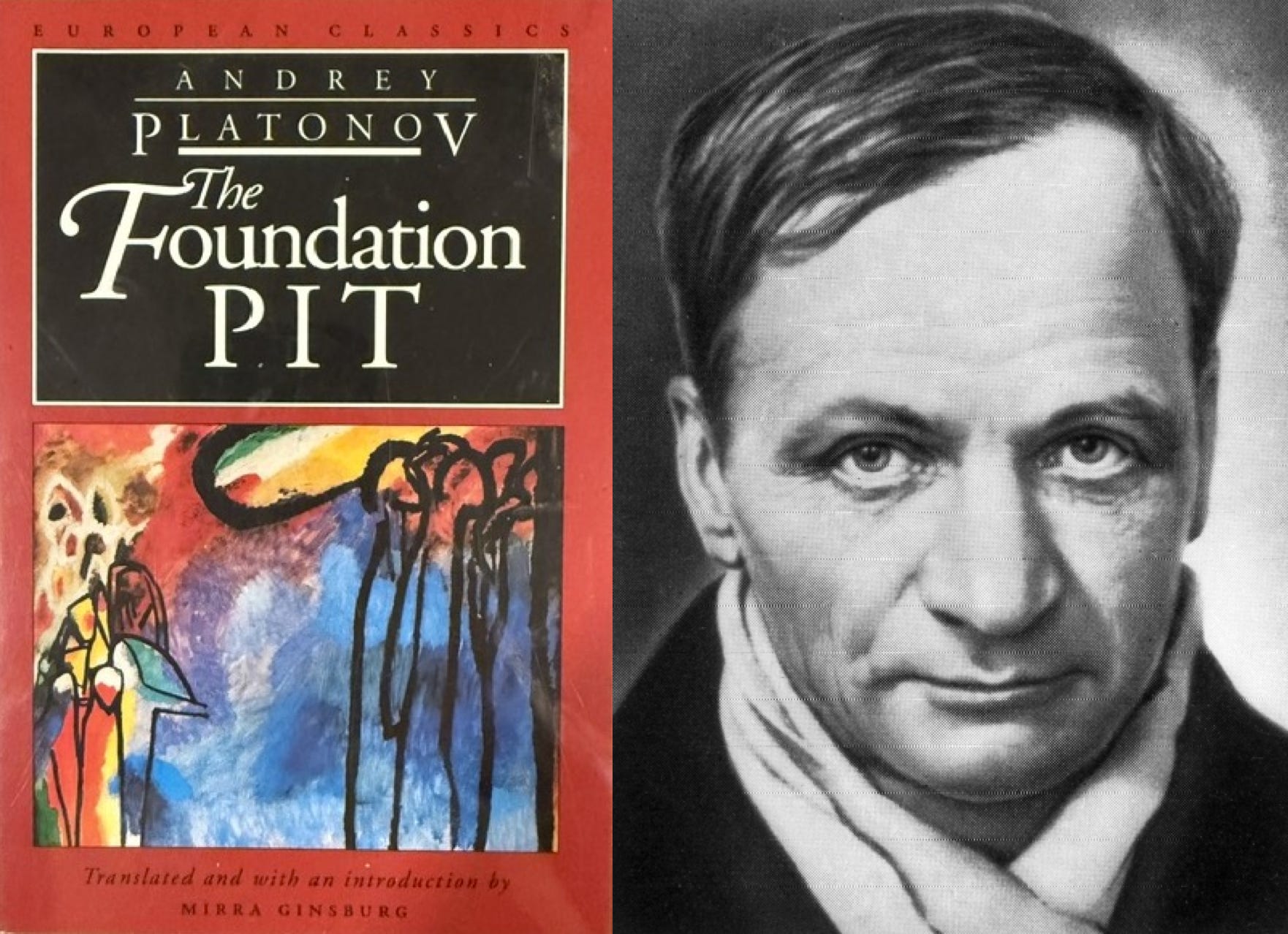
I’m sitting here, reflecting on literature while listening to workers dig a trench for a limestone skirting around my house. Naturally, my thoughts turn to The Foundation Pit and the meaning of life.
The first character we meet in the novel is Voshchev. We are told at the beginning of the story that he used to stop in the middle of his workday at a factory and stare off into space for hours. He explained to his boss that he was trying to figure out the meaning of life, and he claimed that if only he understood that one thing, he would be happy, and then he would work more efficiently. They fired him.
Voshchev then wanders around the countryside until a foreman of a work crew literally stumbles across him sleeping and recruits him into a labor team digging a large pit. The pit will hold a stone foundation for a building to house all the country’s proletarian population. Despite the industrialization going on at the time, this project is pretty pitiful. The workers have no heavy equipment but are instead using shovels and picks; the labor force is only half as large as the project manager expected; and the planned size of the foundation keeps growing.
After we meet several more characters, connected in one way or another with this construction project, the story begins to include surrealist touches: socialized horses who gather all their own forage and drop it into a communal pile; a bear that works in a blacksmith’s shop with superhuman enthusiasm, tirelessly hammering the hot steel; and an entire town with pre-need coffins for every citizen.
At this time in my life I don’t enjoy novels that only make sense when they are interpreted. This includes didactic tales, allegories, parables, and inside jokes. I wasn’t always like that. I used to interpret novels like a Jungian would interpret a dream. I used to find puzzles to solve even when they weren’t there. I probably would have enjoyed the hard-to-ignore symbolism of The Foundation Pit more back then. If Platonov thought he was fooling the censors, he was delusional. Anyone living at the time would have known exactly what, and whom, he was ridiculing.
Fortunately, I didn’t live at the time. But now, I wish I knew more about what went on in the Soviet Union during the Stalin years. The Foundation Pit is pretty funny, but political humor doesn’t work so well if you don’t know all the people or institutions being roasted. So I didn’t get all the jokes, but I think I mostly got the pathos.
The Foundation Pit is the story of a place, a time, and a movement rather than a person. Most of the characters other than Voshchev are representative of one group or another— workers, kulaks1, bureaucrats, foremen, farmers—Voshchev himself, though, is an intelligent and sensitive person, observant and perplexed because his demand for meaning exceeds the current supply. The story drifts away from Voshchev’s point of view to show, in tragicomic vignettes, how forced expropriation is reshaping every part of the country.
Unsurprisingly, the censors prevented this and Chevengur, another of Platonov’s novels, from being published during his lifetime. Born in 1899, he died young in 1951, but it wasn’t until 1968 when the manuscript was first published in Germany. It didn’t see print in Russia until 1986. In fact, Platonov’s writings were suppressed so thoroughly that he was virtually unknown in his own country until decades after his death.
I said I don’t especially enjoy allegorical works, and my appreciation of The Foundation Pit was hampered by the feeling that Platonov’s spirit was looking over my shoulder, chuckling, and saying “get it?” after every sentence. Because of this sense of significance at every turn of phrase, I felt compelled to take the novel “seriously,” despite its cynical Russian humor. But, I’m sorry, to the extent that it has a message, I can’t read it as a novel. As a message, all its aha moments occur when I see what such-and-such represents. That’s not the sort of insight I enjoy. I prefer to stay inside the story—figuring out the psychology of a character, or recognizing the causal connections between events, or appreciating how social interactions are playing out, or guessing at the unstated contours of the storyworld. I also enjoy figuring out how the author can do those things. In contrast to such interior logic, pretty much anything can happen in The Foundation Pit, because events are less controlled by the fictional context than by the needs of Platonov’s message.
Having said that, I nevertheless think that The Foundation Pit is much more than a thinly disguised criticism of the First Five Year Plan.2 It’s better than that. It is layered, compassionate, and sorrowful, and it defies classification. It seems to me that Platonov achieved an unusual, three-way tension. On the one hand, he wants to tell the story of an audacious and heroic movement: the socialization of an entire country and the elimination of private property. On the other hand, the movement, while itself heroic, cannot permit conventional, bourgeois heroes, for that would suggest some individuals are worthier than others. And on the third hand, readers engage best with heroes or martyrs. Platonov must have recognized that an individual hero or a martyr would be all wrong for this novel. So the character with whom we start and finish, Voshchev, is more of a melancholic observer than an actor. The real protagonist is Russia. And in fact Russia—the people, animals, plants, and soil—comes across as both hero and martyr.
The Foundation Pit is not exactly a dystopian novel. While it depicts a world made wretched by intrusive state control, there is nothing futuristic about it. Once Voshchev has left the factory, he enters a world where workers use hand tools and dig the massive foundation pit with shovels. Everyone either walks or rides in carts or on horseback. Communication takes place by letter, not telephone or even telegraph. Presumably there are cities somewhere that are miracles of Soviet industrialization, but the beneficial effects of the ambitious First Five-Year Plan have not touched this part of the country.
Consider this passage. Chiklin is a fellow worker, a man of action who is not sadistic but is capable of unthinking brutality as he does what needs to be done.
And Chiklin plunged his spade into the soft surface of the earth, concentrating his impassively reflective face upon the ground. Voshchev also began to dig deep into the soil, sending his whole strength into the spade. Now he admitted the possibility that children would grow up, that joy would be transformed into thought, and that future man would find peace in that solidly built house and look out of the high window into the spreading world awaiting him outside. He had already destroyed forever thousands of grass shoots, rootlets, and little underground shelters of assiduous creatures, and was now working in a trench of dreary clay. But Chiklin was way ahead of him. He had long put down the spade and taken up a crowbar to crumble the hard, compressed rock below the clay. Chiklin was abolishing the ancient natural order without ability to understand it.
Platonov believed in the ideal of collectivization, but deeply regretted how that ideal was being implemented. He could see a glorious future, but the way forward was through the irreversible destruction of the past and present. Not just all that was bad, but all that was good, too. In the above passage, Voshchev understands the costs to all living creatures; Chiklin understands nothing. Platonov shakes his head sadly because he knows that the Chiklins of the world must prevail. And he also knows that the future has no place for himself or his generation. Only today’s children, properly indoctrinated and ignorant of the past, can inherit the new order and do so in innocence.
Nameless children are present throughout the novel, usually glimpsed briefly as reminders that the future is what all this destruction is about. As Platonov puts it,
[C]hildren are time-ripening in fresh bodies, while he, Voshchev, was being shunted out by hurrying, active youth into the silence of obscurity, as life’s futile attempt to attain its goal.
There is also an important, tragic figure of Nastia, a young girl, who represents an in-between generation. The older generation is hopelessly tied to the past, unable to retrain themselves into the proper sort of citizen needed to populate the world they themselves are building. The new order won’t come to fruition until all those who remembered the past have died. So, when Nastia’s mother dies of starvation and cold, she makes the girl promise to never tell anyone that she comes from a wealthy family. Soon, she can write, with complete sincerity, “Liquidate the kulak as a class. Long live Lenin...”
Much more goes on in the novel than I have indicated. There are dozens of vignettes, some comic, some fanciful, some tragic, but all revealing in some way or other Platonov’s sympathy and compassion for the humans caught up in the threshing machine of progress. Despite my ignorance and initial misgivings, the book moved me.
§ § §
I took a few days off this week to travel and visit with family. Next week, I’ll be traveling again for some volunteer work for the Intercollegiate Ethics Bowl, so there may be another delay. But you can expect the next Decade reflection to be about the collection of short stories, A Sportsman’s Notebook, by Ivan Turgenev. I’ll be reading the Charles and Natasha Hepburn translation in the Everyman’s Library edition.
Once again, I want to let you know I appreciate your interest in this project and your support, in whatever way you show it. Please share with others and take out a free or paid subscription if you have not already done so. All posts from the Decade Project proper will always be free, but don’t let that discourage you from throwing money my way.
Works mentioned in this reflection
If you purchase one of these books from the link, I may receive a small commission.
“A farmer characterized by Communists as having excessive wealth”—Webster’s
A plan begun by Stalin for economic growth of the USSR that included industrialization and collective farming. There were eventually to be thirteen five-year plans.