
Measure for Measure—William Shakespeare
"O, were it but my life! I’d throw it down for your deliverance"

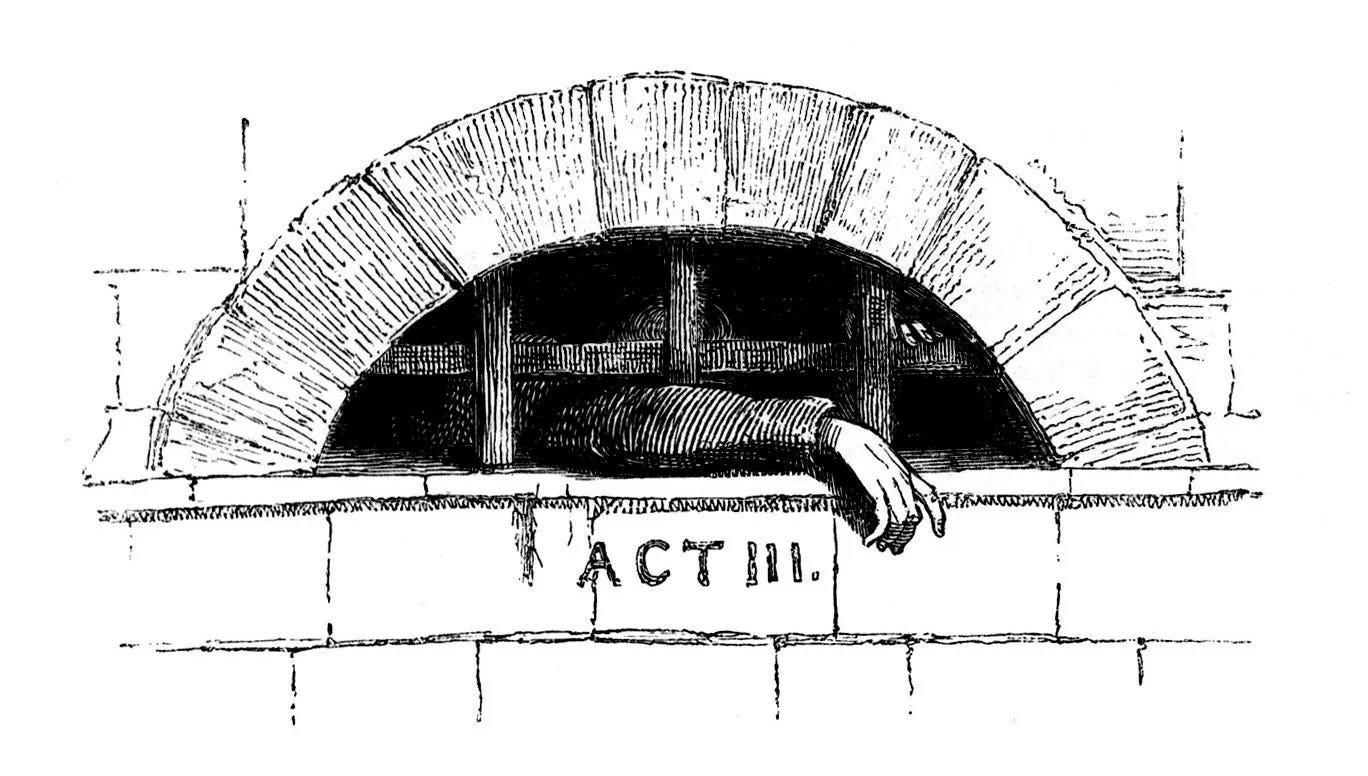
Although listed as a comedy, Measure for Measure often gets labeled as one of Shakespeare’s “problem plays,” which might explain my problem in trying to write about it. It certainly doesn’t fit neatly into any standard category. On the one hand, it has many features of a comedy: disguises, substitutions, irony, some really funny dialogue, and so forth. But on the other hand, it deals with somber topics like executions, sexual extortion, and horror. True, as befits a comedy, all the main characters seem destined for marriages in the final scene; yet two of the marriages get imposed as sentences and one marriage overrides the woman’s plan to join a convent. Almost none of the characters exit the play happily, much less live happily ever after. But, for me, the main problem comes from trying to decide how I feel about any of the play. From one scene to another, any sympathy I start with soon shrivels into moral queasiness. But first, a quick plot summary.
Vincentio, Duke of Vienna, announces his plan to leave town for a while and hand over the reins of government to Angelo, a real prude. Angelo wants to make a good impression, so he adopts a no-tolerance policy against sexual promiscuity: Any man found guilty of pre-marital sex must die. Claudio, engaged to marry Juliet, jumps the gun and gets her pregnant, so Angelo decides to make an example of him. While awaiting his execution in jail, Claudio sends for his sister, Isabella, a novitiate at the local convent, to plead with Angelo for leniency. She does so, but Angelo gets the hots for her, and offers to exchange Claudio’s life for her virginity. A brother’s head for a maidenhead; measure for measure, as it were. She rejects Angelo’s advances and then goes to break the bad news to Claudio. He tells her, Now, wait a minute! Won’t you do that little thing for me? She tells him to go to hell. Meanwhile, the Duke, who actually didn’t leave town after all but has disguised himself as a friar so he could spy on Angelo, overhears this loving exchange between siblings and comes up with a plan. It seems that Angelo had broken off an engagement a few years ago with a certain Mariana after learning that she had lost her dowry. So the fake friar tells Isabella to agree to Angelo’s proposal but then to trick him into having sex with Mariana instead. If the trick works, Claudio can live, and impregnating Mariana will serve Angelo right. However, the devilish Angelo plans to screw Isabella and kill Claudio anyway, so some logistical shuffling must take place before we reach a “happy” ending with all the main characters looking forward to their marriages, maybe.
I really liked this play, not that it kept me in stitches, but because it has a lot of philosophical meat to chew on. Sex or death crops up on almost every page, making this so-called comedy quite dark. True, no one gets killed (although a severed head does play an important role). Still, the threat of an oh-so-pious execution looms over the entire play. In fact, as part of his clever scheme, the Duke lies to Isabella, telling her of Claudio’s execution, in order to manipulate her into playing along with the convoluted barrage of revelations and reckonings he has planned for the last scene. Perhaps he doesn’t trust Isabella’s acting ability, so he makes sure she plays her role well by convincing her of her brother’s murder. Well, I don’t know how I should feel about that. But, worse, maybe he doesn’t so much doubt her thespian talents as want to send her reeling from shock after shock so he can make her an offer she can’t refuse.
Another troubling issue arise from Angelo’s sadism. We have all heard of priggish sexual preservers who turn into sexual predators. When Isabella comes to plead for her brother’s life, she impresses Angelo with her purity and intelligence. Instead of respecting her innocence and acknowledging her well-reasoned case, his passion becomes inflamed. Clearly, though, this passion of his reeks more of power than of sex. He wants to ruin her, and sexual conquest serves merely as the means to that end. If he only wants a good time, he would honor the bargain, Isabella’s body for Claudio’s life. But the real consummation involves crushing the sister by killing the brother. Again, we call this comedy?
After hinting around without her catching the drift, Angelo grows more insistent but still subtle, apparently unwilling to crudely state his indecent proposal, but she either fails or refuses to grasp his meaning. The more innocent she acts, the more aggressive he becomes. Finally, he says in exasperation:
Angelo: Redeem thy brother
By yielding up thy body to my will;
Or else he must not only die the death,
But thy unkindness shall his death draw out
To ling’ring sufferance. Answer me tomorrow,
Or, by the affection that now guides me most,
I’ll prove a tyrant to him.
Again, the actors might carry the humor in a live performance, but the theme? Not so funny.
On the other hand, one of the great comedic scenes occurs when Isabella confesses to Claudio that she won’t give in to Angelo’s terms—Sorry, brother, you’ll just have to die. Claudio starts off as quite the stoic and Isabella approves.
Claudio: … If I must die,
I will encounter darkness as a bride
And hug it in mine arms.
Isabella: There spake my brother; there my father’s grave
Did utter forth a voice. Yes, thou must die:
Thou art too noble to conserve a life
In base appliances. …
Then she tells him the terms Angelo demanded.
Isabella: … Dost thou think, Claudio,
If I would yield him my virginity
Thou mightst be freed?
Claudio: O heavens it cannot be.
Isabella: Yes, he would give’t thee, from this rank offence,
So to offend him still. This night’s the time
That I should do what I abhor to name,
Or else thou diest to-morrow.
Claudio: Thou shalt not do’t.
Isabella: O, were it but my life!
I’d throw it down for your deliverance
As frankly as a pin.
Claudio: Thanks, dear Isabel.
But now he starts to waver and think of fornication as not all that bad a sin, and she tries to talk him out of what I would call “dier’s remorse.”
Claudio: Death is a fearful thing.
Isabella: And shamed life a hateful.
But he reflects a bit more about what he has just committed himself to and delivers this soliloquy worthy of high tragedy.
Claudio: Ay, but to die, and go we know not where;
To lie in cold obstruction, and to rot;
This sensible warm motion to become
A kneaded clod; and the delighted spirit
To bathe in fiery floods or to reside
In thrilling region of thick-ribbed ice;
To be imprison’d in the viewless winds,
And blown with restless violence round about
The pendant world; or to be worse than worst
Of those that lawless and incertain thought
Imagine howling—’tis too horrible.
The weariest and most loathed worldly life
That age, ache, penury, and imprisonment,
Can lay on nature is a paradise
To what we fear of death.
Isabella: Alas, alas!
Claudio: Sweet sister, let me live.
What sin you do to save a brother’s life,
Nature dispenses with a deed so far
That it becomes a virtue.
Isabella. O you beast!
O faithless coward! O dishonest wretch!
Wilt thou be made a man out of my vice?
Is’t not a kind of incest to take life
From thine own sister’s shame? …
Speaking of death and dying, one of the funniest moments of an Shakespearean play I’ve read takes place later in this same dungeon. Just as Falstaff steals the show in Henry IV, part 1, Barnardine, a murderer, does the same here, making the most lasting impression on me of any other character here. He has only seven lines, but he delivers them with the greatest economy I can imagine. Angelo has demanded Claudio’s death and orders the head brought to him as a sort of proof of severance. So, the executioner needs a head, and he decides to use Barnardine’s who has spent the last nine years in jail awaiting execution. So Abhorson, the executioner, and Pompey, a clown impressed into service as the executioner’s assistant, try to summon Barnardine to die.
Abhorson: What hoa, Barnardine.
Barnardine: [within] A pox o’ your throats! Who makes that noise there? What are you?
Pompey: Your friends, sir, the hangman. You must be so good, sir, to rise and be put to death.
Barnardine: [within] Away, you rogue, away, I am sleepy.
Abhorson: Tell him he must awake, and that quickly too.
Pompey: Pray, master Barnardine, awake till you are executed, and sleep afterward.
But Barnardine explains why he declines to let them execute him, and the Duke, still disguised as a friar, gets involved.
Barnardine: I have been drinking hard all night, and I will have more time to prepare me, or they shall beat out my brains with billets. I will not consent to die this day, that’s certain.
Duke: O, sir, you must; and therefore I beseech you
Look forward on the journey you shall go.
Barnardine: I swear I will not die to-day for any man’s persuasion.
Duke: But hear you—
Barnardine: Not a word; if you have anything to say to me, come to my ward; for thence will not I today. Exit
And that apparently settles the matter.
The first performance of Measure for Measure took place in December, 1604, toward the end of Shakespeare’s productive years. The term, “problem play,” describes a type of play in the late nineteenth century, like those by Ibsen, characterized by realism and dealing frankly with social problems. Frederick S. Boas borrowed the term and applied it to a small cluster of puzzling works by Shakespeare, this one included. But I don’t see Measure for Measure as either realistic or as addressing social problems. I would call it cynical to the point of nihilism and morally ambiguous. If anything, it resembles the so-called comedies of Chekhov more than the dramas of Ibsen. Thus, even though I don’t agree with Tolstoy’s evaluation, I think I now appreciate his comparison of Shakespeare and Chekhov when he advised the latter to give up writing plays and stick with shorts stories. “Shakespeare’s play are bad,” he said, “but yours are worse.”
§ § §
I’ve noticed a distinct drop-off in new subscriptions since I started covering Shakespeare. So, as much as I’ve enjoyed him, I’ll try shifting my focus to something that may have broader appeal. I have an old copy of Nikos Kazantzakis’s The Last Temptation of Christ, translated by P. A. Bien, so I propose to tackle that next and see if it can spark some interest, or at least offend a few people.
I just purchased Will in the World: How Shakespeare became Shakespeare by Stephen Greenblatt. So I’ll read that soon and then, armed with a better background, come back at a later time to explore some more plays and sonnets.
Thank you for reading these reflections on great works of literature. If you haven’t already subscribed, please consider doing so for free and receive each reflection in your in-box as soon as it comes out (I shoot for once a week). If you already have a free subscription and wish to support me further, consider upgrading to a paid subscription. I try to buy only hardback copies, and I much prefer used books, so I can promise to put your paid subscriptions to work right away.
Works mentioned in this post
Measure for Measure, by William Shakespeare
Henry IV, part 1, by William Shakespeare
The Last Temptation of Christ, by Nikos Kazantzakis, translated by P. A. Bien
Will in the World: How Shakespeare became Shakespeare by Stephen Greenblatt
I thoroughly enjoyed your review of Measure For Measure. I only had to Google three references. (I love learning new things. Now, if I just remember them.) I appreciate your translating Shakespeare into English. But even more, I appreciate the analysis, context, humor, and your moral meditations. Now, get back to work so that I may effortlessly enhance my personal culture. 🙂
Angelo is a Trunchbullish sort of character and I can see Eric Idle playing Bernadine with John Cleese playing the executioner. Hilarious.